Quick Answer
To get a job in the UAE, you need the right role focus, a UAE-optimized (ATS-friendly) CV, a strategic application approach (portals + recruiters), and respectful networking. Once you receive a job offer, employers typically process the employment contract and the work permit, and then the work visa steps in the UAE private sector.
TL;DR: Your UAE Job-Getting Plan
- Target one role + seniority level: clarity helps recruiters match you faster.
- Build a UAE-optimized CV: use local keywords, keep formatting clean, and highlight achievements.
- Apply strategically: prioritize aligned roles; don’t “spray and pray”.
- Use recruiters and agencies professionally: focus on agencies that match your industry.
- Network in the UAE the right way: relationship-driven, respectful, and consistent.
- Understand the employer-led process: job offer → contract → work permit → work visa steps.

Why UAE Hiring Feels Different (and How to Work with It)
UAE hiring is usually faster when your application is “easy to shortlist.” That means your CV is easy to read for ATS systems, your profile aligns with the exact role recruiters are searching for, and your communication is clear and professional. A recruiter-first strategy focuses on visibility and alignment, not just volume.
Once a company is interested, the UAE private-sector employment process follows a structured pipeline: a formal job offer, signing the employment contract, getting the work permit, and then receiving the work visa. This structure is why it helps to understand what happens after the offer stage.
Understand the UAE Private-Sector Employment Pipeline
Job offer to work permit to work visa
In the UAE private sector, the employment process generally involves receiving a formal job offer, signing the employment contract, receiving the work permit, and then receiving the work visa. Employers manage key parts of this process, and the employment contract details matter.
Employment contracts have defined models
Employment contracts in the private sector can be full time or part time, and work arrangements may include options such as remote work, flexible work, job sharing, or temporary work (depending on the arrangement).
Why your offer stage needs attention
Before you accept, you should read the contract provisions carefully and ask questions if anything is unclear. Employment-contract workflows are managed through official services and contract issuance/renewal mechanisms.
Step-by-Step: How to Get a Job in UAE (From Today)
Step 1: Choose a single target role (and commit to it)
Pick one primary role, one industry focus, and the seniority level you’re truly applying for. When you target multiple directions at once, recruiters often interpret it as lack of focus.
Step 2: Create a UAE-optimized, ATS-friendly CV
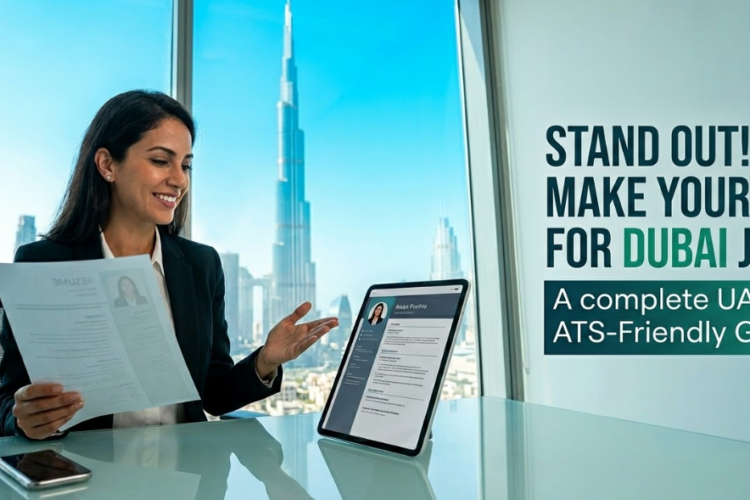
To improve your odds in the UAE market, tailor your CV for the Dubai/UAE job market and the role description: use industry-specific language, highlight relevant skills, and showcase measurable outcomes instead of only responsibilities.
Keep your CV formatting clean and text-based so it works well with Applicant Tracking Systems (ATS). Use standard headings and avoid designs that ATS may not parse.
Step 3: Align your job titles and keywords with recruiter searches
Recruiters commonly search databases by job title and keywords. A recruiter-first approach therefore aligns your CV headline, core skills, and experience keywords with how the role is commonly described in the job posting.
Step 4: Apply strategically (portals + targeted outreach)
Job portals are useful, but use them with intention: apply selectively to roles that match your target, and avoid sending the same generic CV to unrelated positions. Recruiter-first systems treat portals as support for a broader approach.
Step 5: Use recruitment agencies—carefully
Don’t approach agencies randomly. Prioritize agencies that are relevant to your industry and role level, and keep your CV and LinkedIn aligned so recruiters can quickly shortlist you.
Step 6: Network effectively (UAE-style)
In Dubai and the UAE, networking is relationship-driven. Effective networking is long-term, respectful, and consistent rather than aggressive or transactional. Your goal is professional visibility and credibility.
In practice, recruiters and hiring managers often discover candidates through LinkedIn and through connections. That’s why you should build a clear online presence that matches your CV.
Common Mistakes That Slow Down Your UAE Job Search
- Targeting multiple roles at once instead of committing to one clear direction.
- Submitting a non-tailored CV that doesn’t match the job description keywords.
- Applying in bulk without alignment (high volume, low relevance).
- Networking like it’s “numbers chasing” instead of building trust and credibility.
- Ignoring the offer stage process and not understanding the contract/work-permit/work-visa pipeline.
Interview Preparation for UAE Employers
When interviews are scheduled, focus on role clarity and cultural fit: be ready to explain how your experience aligns with the job responsibilities, and be prepared to discuss your readiness to start and work under the UAE employment process. The more aligned and consistent your CV/profile are with the role, the easier it is for employers to evaluate you.
If you are relocating from outside the UAE, communicate your timeline professionally and keep your documents organized so you can move quickly if you receive an offer.
Conclusion: Your UAE Job Search System
A strong UAE job search isn’t just about applying. It’s about clarity (one target role), alignment (CV keywords + ATS-friendly structure), visibility (recruiter-first approach), and credibility (UAE-appropriate networking). Once the right offer comes, understanding the job offer → employment contract → work permit → work visa pipeline helps you move with confidence.
Next step: make your CV recruiter-ready
If you want a fast improvement, start with your CV tailoring and keyword alignment for the exact roles you’re targeting. Use clean formatting and highlight achievements relevant to UAE employers.
Suggested internal guides:
Frequently Asked Questions
Q: After I get a job offer, what happens in the UAE employment process?
A: In the UAE private sector, the employment process typically follows a sequence: formal job offer, signing the employment contract, receiving the work permit, and then receiving the work visa.
Q: Does the type of employment arrangement matter?
A: Yes. Employment contracts can be full time or part time, and work arrangements may include options like remote work, flexible work, temporary work, or job sharing depending on the arrangement.
Q: How should I tailor my CV for UAE job applications?
A: Tailor your CV to the UAE job market and the job description: use role-relevant language, emphasize achievements, and keep formatting clean so it’s ATS-friendly.
Q: Is networking important for landing interviews in Dubai?
A: Networking is important and is relationship-driven. Effective networking is long-term, respectful, and consistent, and it often supports recruiter visibility and referrals.
Q: Should I apply to multiple job titles at the same time?
A: For a recruiter-first approach, it’s usually better to pick one primary target role and seniority level. A clear target helps recruiters interpret your application as aligned rather than unfocused.
Q: What’s the biggest mistake in UAE job searching?
A: Many candidates focus on volume instead of alignment. Instead of submitting the same generic CV broadly, target the right roles, optimize keywords for ATS/recruiter matching, and keep your CV and profile consistent.